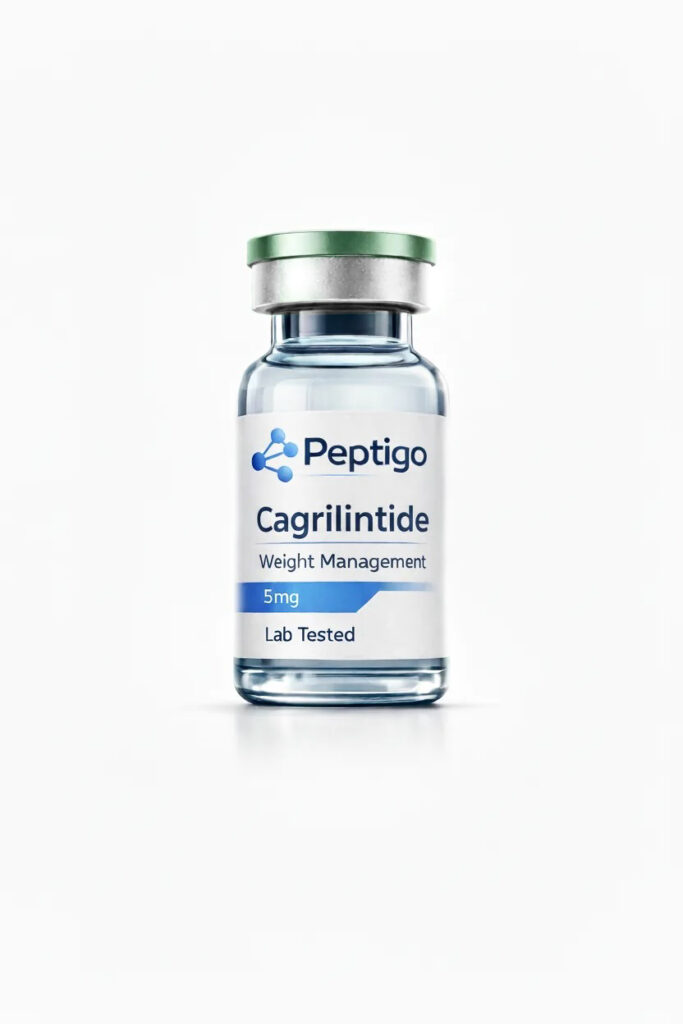
Research Use Only · Not for Human Consumption
25% off all peptides · applied automatically · Free Shipping on $250+ · View Lab Reports
● In stock
● Weight Management
Cagrilintide
Cagrilintide · CAS 1415456-99-3
Sale on nowEvery peptide 25% offAlready in the price — nothing to enter
Lyophilized Cagrilintide — third-party HPLC tested, supplied for laboratory research use only.
Cagrilintide is a synthetic amylin analogue that solves a specific problem with the parent hormone. Native amylin is prone to amyloid aggregation, which makes it difficult to formulate and limits the research windows available for it. Cagrilintide’s subs… Read more ↓
🚚 Free shipping over $250
Third-party HPLC tested
COA included per lot
Ships same day, Canada-wide
Card or Interac e-Transfer accepted
Secure checkout
99%+ HPLCIdentity & purity
COA per lotDownloadable
Canada-wideSame-day dispatch
LyophilizedCold-chain packed
Details
Everything about this vial
What is Cagrilintide?
Cagrilintide is a synthetic amylin analogue that solves a specific problem with the parent hormone. Native amylin is prone to amyloid aggregation, which makes it difficult to formulate and limits the research windows available for it. Cagrilintide’s subs…
For laboratory & research use only. Not a drug, supplement, or food; not for human or animal consumption, diagnostic, or therapeutic use. No medical claims are made.
How it’s handled in research
Supplied as a lyophilized powder. Reconstitute with bacteriostatic water to the working concentration required by your protocol — use the reconstitution calculator to compute volume per mg.
Storage & stability
Store the sealed lyophilized vial at −20°C, desiccated and away from light. Once reconstituted, keep refrigerated and use within the window appropriate to your protocol.
Shipping & payment
In-stock items ship the same business day, Canada-wide, in cold-chain packaging. Free shipping on orders over $250. Pay by Visa or Mastercard — credit or debit — or by Interac e-Transfer straight from your bank app.
Specification
The spec sheet
CAS Number
1415456-99-3
Purity (HPLC)
≥ 99%
Form
Lyophilized powder
Storage
−20°C, desiccated
Use
Research Use Only
99+
Certificate of Analysis
HPLC · MS confirmation · endotoxin screen — included per lot
View lab reports →
Need to reconstitute?Open calculator →
Reviews
What customers say
Show
No reviews yet for this product. If you have ordered it, yours would be the first.
Catalog
Researchers also reference
AOD-9604Weight Management
Original price was: $60.00.$45.00Current price is: $45.00.
L-CarnitineWeight Management
Original price was: $45.00.$33.75Current price is: $33.75.
TirzepatideWeight Management
Price range: $71.25 through $150.00
SLU-PP-332Weight Management
Original price was: $95.00.$71.25Current price is: $71.25.
SemaglutideWeight Management
Price range: $30.00 through $48.75
RetatrutideWeight Management
Price range: $63.75 through $150.00
Cagrilintide
Reviews
There are no reviews yet.