Vial
mg
5 mg ÷ 2 mL = 2.5 mg/mL → 0.25 mg ÷ 2.5 = 0.10 mL × 100 = 10 units
Lyophilized: cool, dark, room temp OK.
Reconstituted: refrigerate at 2–8°C.
Discard 28 days after reconstitution.
Calculate reconstitution volume, syringe units, and cost per dose. For laboratory research use only.
 Peptigo
·
Calculator
Peptigo
·
Calculator
Bacteriostatic water, insulin syringes, and alcohol pads — everything required to mix and draw a clean dose.

Sterile diluent for reconstituting lyophilized peptides. 10 mL or 30 mL multi-dose vial, USP grade.
Add to order →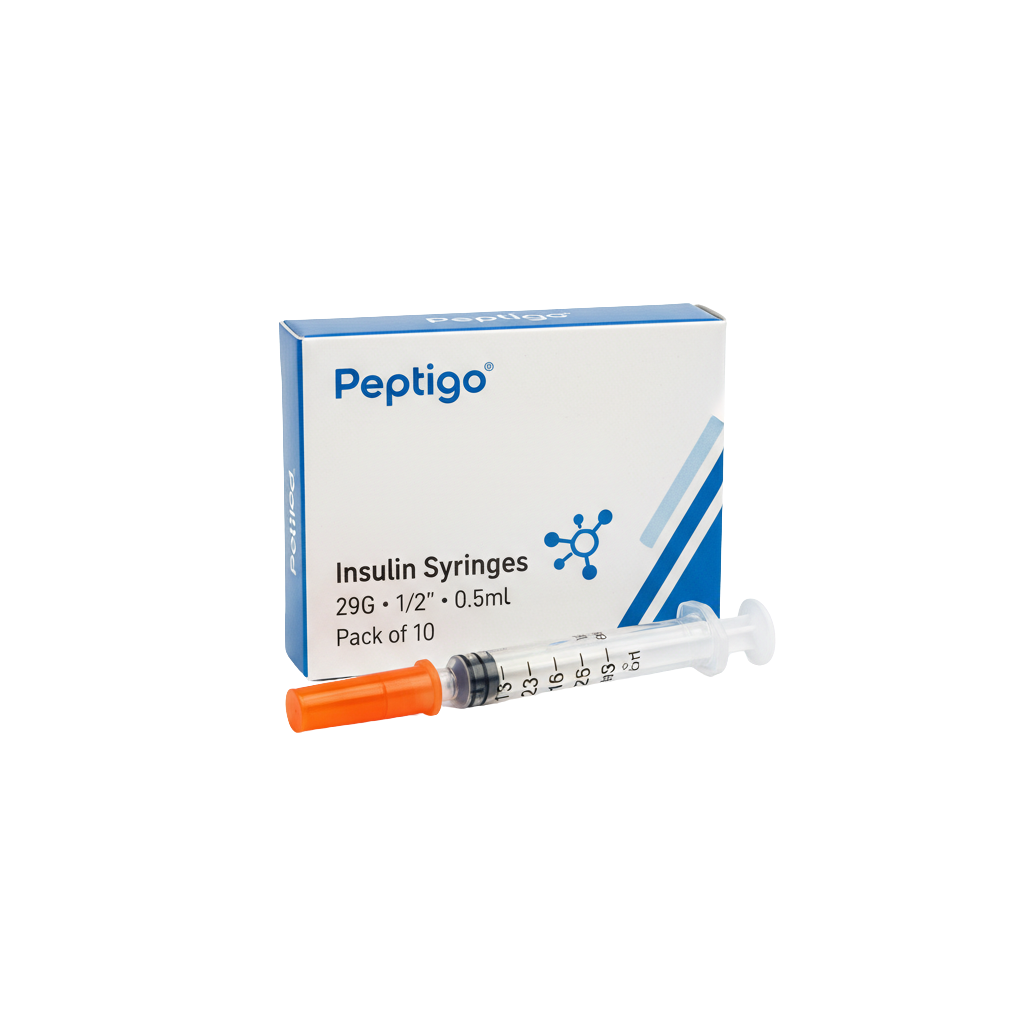
29G · 1/2″ · 0.5 mL U-100 insulin syringe. Sterile, individually wrapped. Order by the unit.
Add to order →
70% isopropyl alcohol pad, individually wrapped. For vial septum and injection-site prep. Order by the unit.
Add to order →The calculator does the unit conversions for you. The math is deterministic — no approximation, no rounding tricks.
Pick from the catalog presets to auto-fill the vial mass, or enter a custom value in milligrams.
Enter how much bacteriostatic water you plan to add to the vial. Common volumes are 1 mL, 2 mL, or 3 mL.
The hero number is the unit mark to draw to on a U-100 (or U-40) insulin syringe. Toggle syringe type if needed.
If it’s your first time, this is the whole process: from cold vial to drawn syringe. Takes about 5 minutes once you’ve done it once or twice.
You need four things: the lyophilized peptide vial, a vial of bacteriostatic water, an insulin syringe (29G, U-100), and an alcohol prep pad. Bac water, syringes, and prep pads are all in the supplies section of the catalog. Don’t use sterile water for injection — bacteriostatic water has 0.9% benzyl alcohol that gives reconstituted peptide a 28-day refrigerated shelf life. Sterile water gets you ~24 hours.
Pick your peptide from the preset dropdown, or punch in the vial mass manually. The calculator auto-suggests a recon volume that gives a clean concentration (usually 2 mL for a 5 mg vial). Pick your dose with the quick-dose chips. The animated syringe shows you exactly which unit mark to draw to.
Tip: if the syringe shows red (“too small to draw accurately”), use less bacteriostatic water — that increases concentration and gives you more units per dose.
Tear open an alcohol prep pad. Wipe the rubber stopper of the bacteriostatic water vial, then the rubber stopper of the lyophilized peptide vial. Let them air-dry for ~10 seconds — don’t blow on them, don’t touch the surface after wiping.
Pull the syringe plunger to the calculated mL volume (e.g., 2 mL = the 100-unit mark on a U-100 syringe). Insert the needle into the bac water vial through the rubber stopper — a slight push at an angle helps the needle slide in clean without coring. Push the plunger to inject the air you drew, then flip the vial upside-down and pull back to draw the water to your target volume.
Pull the needle out of the bac water vial and insert into the lyophilized peptide vial. This is the part most people get wrong. Aim the needle so the water runs down the inner wall of the vial — don’t blast the water directly at the lyophilized cake. Direct streams can denature peptides. Push the plunger slowly — 5–10 seconds for 2 mL.
Pull the syringe out. Hold the vial upright and gently swirl it in slow circles for 30–60 seconds until the lyophilized cake fully dissolves. Most peptides dissolve in seconds — clear solution. Some (like CJC-1295 with DAC, NAD+) take a minute or two. Never shake the vial — frothing and air bubbles damage peptide structure. If you see foam, you shook it.
Click “Print vial label” in the calculator above to generate a 4×2 inch sticker with the peptide name, concentration, reconstitution date, and 28-day expiry. Stick it on the vial. Date-keeping prevents using compromised material weeks later.
Reconstituted peptides go in the fridge at 2–8°C between uses. Don’t freeze (ice crystals damage peptide structure). Don’t leave at room temperature for more than an hour. Most peptides degrade ~50% per week if left out vs. ~5% per week refrigerated.
Wipe the rubber stopper with a fresh alcohol pad before each draw. Pull the syringe to the unit mark the calculator gave you. Insert through the stopper, flip the vial, draw to the mark. Tap any air bubbles to the top and push them back into the vial before withdrawing the needle.
If you’ve got a question, someone’s asked it before. Quick, plain-English answers with the math when it matters.
Wipe both vial septums with alcohol. Draw your calculated volume of bacteriostatic water into a U-100 insulin syringe. Slowly inject it down the inner wall of the lyophilized peptide vial — never directly at the powder. Swirl gently for 30–60 seconds until clear. Refrigerate. The full step-by-step is in the guide above.
Bacteriostatic water contains 0.9% benzyl alcohol as a preservative. Sterile water is just sterile water with no preservative. The benzyl alcohol gives reconstituted peptides a ~28-day refrigerated shelf life. Sterile water gives about 24 hours. For multi-dose research vials, always use bacteriostatic water.
A 29-gauge, 1/2″ (12.7 mm), 0.5 mL U-100 insulin syringe is the standard for peptide research. The thin needle minimizes coring (rubber chunks getting drawn into the vial), the 0.5 mL barrel gives you fine resolution at low volumes, and U-100 markings are universal. We carry them individually so you only buy what you need.
With bacteriostatic water and refrigeration at 2–8°C: 28 days for most peptides. Some (like NAD+, GHK-Cu, CJC-1295 with DAC) hold up well for the full window; others lose potency past ~21 days. Use the storage countdown in the calculator above — it shows you the exact discard date based on today.
Mg (milligram) = 1/1000 gram. Mcg (microgram) = 1/1000 mg. So 1 mg = 1000 mcg. IU (International Unit) is a measure of biological activity, not mass — used for hormones like HGH and HCG. The conversion between mg and IU varies per peptide and isn’t 1:1. The calculator handles mg/mcg automatically; for IU-dosed peptides, see the product page.
Three reasons: (1) the 29G needle is thin enough to minimize coring through the vial septum, (2) the U-100 unit markings are universal and let you accurately measure tiny volumes (50 mcg is just 1–2 units on most concentrations), (3) the 0.5 mL barrel gives more fine-grained resolution than a standard 1 mL syringe.
Refrigerate at 2–8°C in the original glass vial. Don’t freeze — ice crystals damage peptide structure. Keep the vial upright, away from direct light, and don’t leave at room temperature for more than an hour at a time. After the 28-day window, discard remaining liquid regardless of how much is left.
No. Shaking creates foam and air bubbles, which damage peptide structure and reduce potency. Always swirl gently in slow circles — most peptides dissolve in 30–60 seconds with gentle swirling. If a peptide is taking longer than 2 minutes, give it another minute of swirling rather than shaking.
The math: concentration (mg/mL) = vial mass (mg) ÷ recon volume (mL). Volume per dose (mL) = desired dose (mg) ÷ concentration (mg/mL). Insulin syringe units = volume per dose (mL) × 100 (for U-100). Example: 5 mg vial in 2 mL water = 2.5 mg/mL. For a 250 mcg dose: 0.25 / 2.5 = 0.1 mL = 10 units on a U-100 syringe.
Depends on the vial size and how small your dose is. Rule of thumb: aim for a concentration that puts your typical dose between 5–25 units on a U-100 syringe — that’s the sweet spot for accurate measurement. Most 5 mg peptide vials get 2 mL of bac water (= 2.5 mg/mL). Larger vials (50–80 mg blends) take 5 mL for the same reason.
Most peptides should be completely clear after reconstitution. Cloudiness can mean: (1) the peptide hasn’t fully dissolved yet — give it another minute of swirling, (2) the peptide was stored or shipped at the wrong temperature, (3) very rarely, contamination. If it stays cloudy after 5 minutes of gentle swirling and the vial was handled properly, contact the supplier.
No. Each insulin syringe is for a single use. Reusing them dulls the needle (more pain on injection, more vial-stopper coring), risks bacterial contamination, and damages the rubber plunger. Order syringes individually so you have exactly the count you need.
Lyophilized = freeze-dried. The peptide is mixed with water, frozen, then the water is removed under vacuum, leaving a dry powder cake at the bottom of the vial. Lyophilized peptides are stable at room temperature for transit and can be stored refrigerated for years before reconstitution. Adding bacteriostatic water “wakes them up” into a liquid solution.
Yes. U-100 syringes have 100 unit markings spread across 1 mL of barrel — 1 unit = 0.01 mL. U-40 syringes have 40 markings on the same barrel — 1 unit = 0.025 mL. U-100 is the global standard for human insulin and peptide research. U-40 is used in veterinary settings. Always check which type you have — the calculator above handles both.
No. Lyophilized peptides are shelf-stable at room temperature for 30+ days. Once you reconstitute (add bacteriostatic water), the clock starts — refrigerate from that moment. If you bought a peptide and aren’t ready to reconstitute, store the dry vial in a cool dark cupboard or fridge until you’re ready.
Coring is when the needle punches a small chunk of rubber out of the vial septum, contaminating your solution. Prevent it by: (1) using a 29G or thinner needle, (2) inserting at a slight angle (~15°) instead of straight in, (3) using a steady push rather than a stab, (4) not reusing needles (they get duller with each use). If you ever see a black/grey speck floating in your solution, that’s likely a rubber core — discard the vial.
No. Pharmaceutical-grade peptides are produced under cGMP manufacturing standards with full regulatory oversight — they’re approved for human/animal medical use. Research-grade peptides are produced for laboratory in-vitro research only and are not regulated for clinical use. Peptigo’s catalog is research-grade only — for laboratory protocols, not human or veterinary administration.
A 1-page PDF you can print and tape inside your fridge or cabinet — concentrations, units-per-dose, and storage windows for the whole catalog. No login, just your email.
You’re added to our newsletter (lab updates, restock alerts, member pricing). Unsubscribe any time.
Math examples assuming standard reconstitution into bacteriostatic water with a U-100 insulin syringe. Not dosing recommendations.
All values shown are direct math outputs (concentration = mass ÷ volume; units = dose ÷ concentration × 100). No clinical interpretation. For laboratory research use only. Prices on our catalog are listed in Canadian dollars (CAD). HCG and HGH are dosed in IU (not mg) and are not included in this reference — see each product page for recon guidance.