Description
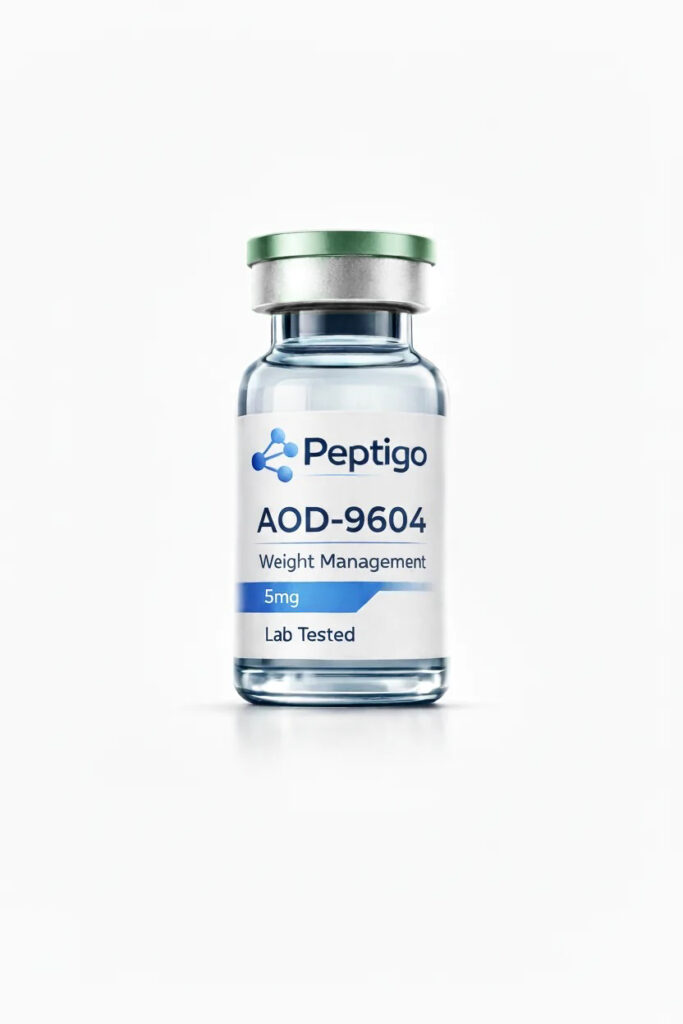
AOD-9604 is a fragment of a fragment. Full-length hGH runs 191 residues; the lipolytic domain of hGH runs from residues 176 to 191; AOD-9604 is that 16-residue fragment with an extra N-terminal tyrosine bolted on for stability. It retains the lipid-metabolism research activity of the parent hormone without the receptor-binding growth effects. That dissociation is the entire reason it exists as its own compound.
Proposed Mechanism
The mechanism in adipocyte research does not run through the GH receptor. The working model points to beta-3 adrenergic receptor pathway activation instead, which is a clean separation from the hGH somatotropic pathway. Ng and Bornstein (1978) originally characterized the 176-191 lipolytic fragment in the parent hormone. Heffernan and colleagues refined the modified AOD-9604 variant in 2000 and 2001 with improved pharmacokinetic properties, which is where the clinical research history starts.
Research Literature
Ng and Bornstein (1978) is the characterization paper for the lipolytic domain of hGH. Heffernan et al. (2000, 2001) developed AOD-9604 itself. Ng et al. (2000, Hormone Research) characterized the lipolytic activity of hGH(177-191) in adipocyte assays. Metabolic Pharmaceuticals (Australia) conducted the human pharmacokinetic research in the early 2000s. The N-terminal tyrosine addition matters: it improves metabolic stability over the unmodified 15-residue fragment while preserving the domain’s activity profile.
Further reading: PubMed references for this compound.
Research Applications
Used in adipocyte lipolysis research, beta-3 adrenergic receptor pathway studies, and hGH-fragment structure-activity research. The modified C-terminal fragment isolates the lipid-metabolism domain from full GHR-mediated signaling.
Supplied strictly for laboratory research use. Not for human or veterinary use.
Reconstitution
Supplied as a lyophilized powder. Reconstitute with bacteriostatic water prior to use. Use the Peptigo reconstitution calculator for guidance on volume and concentration.
Storage
- Unopened: room temperature up to 30 days during transit; refrigerate at 2-8°C long-term.
- Reconstituted: refrigerate at 2-8°C; stable 4-6 weeks. Protect from light.
Quality Verification
Every batch is independently tested by Janoshik Analytical. Certificates of Analysis include HPLC-UV purity, LC-MS identity confirmation, LAL bacterial endotoxin quantification, and USP <71> sterility testing.
Not a drug, supplement, or cosmetic. For in vitro research use only. Not for human consumption.
Frequently Asked Questions
Is this product legal to purchase in Canada for research use?
Peptigo supplies all products strictly for laboratory and in vitro research use. The compound is not a drug, supplement, or cosmetic, and is not sold for human or veterinary use. Researchers purchasing for their own laboratory work, university research programs, or independent in vitro protocols are the intended customer base. Health Canada’s April 2026 advisory specifically addresses unauthorized injectable peptide use; the research-use framing of this product is independent of that consumer-use category.
How is purity verified, and where can I see the Certificate of Analysis?
Every batch is tested independently by Janoshik Analytical, an accredited third-party laboratory. The standard testing panel includes HPLC-UV purity verification, LC-MS identity confirmation, LAL bacterial endotoxin quantification, and USP sterility testing. The Certificate of Analysis for each batch is available on the product page after purchase, and the testing methodology is detailed on the Lab Testing reference page.
What is the standard reconstitution and storage protocol for laboratory use?
The compound is supplied as a lyophilized powder. The standard diluent for reconstitution in research protocols is bacteriostatic water (0.9% benzyl alcohol). The Peptigo reconstitution calculator handles the volume-and-concentration arithmetic for a given target research dose. Unopened lyophilized peptide is stable at room temperature for up to 30 days during transit and should be refrigerated at 2-8°C for long-term storage. Reconstituted peptide should be refrigerated at 2-8°C and is typically functional for 4-6 weeks; protect from light.
Frequently Asked Questions
What is AOD-9604?
AOD-9604 is a synthetic fragment of human growth hormone (the 176-191 region). In research it is studied for its effects on fat metabolism. The human evidence base is limited, with mixed trial results, so it sits well behind the GLP-1 class in terms of data.
AOD-9604 vs GLP-1 peptides for research, are they comparable?
Not really. The GLP-1 class (semaglutide, tirzepatide) has extensive human trial data, while AOD-9604’s best human study was small and a larger one did not meet its endpoint. We put this in context in our GLP-1 research guide.
Is AOD-9604 legal to buy in Canada?
AOD-9604 is a research-use-only material in Canada, not approved for human use. See are peptides legal in 2026.
{“@context”: “https://schema.org”, “@type”: “FAQPage”, “mainEntity”: [{“@type”: “Question”, “name”: “What is AOD-9604?”, “acceptedAnswer”: {“@type”: “Answer”, “text”: “AOD-9604 is a synthetic fragment of human growth hormone (the 176-191 region). In research it is studied for its effects on fat metabolism. The human evidence base is limited, with mixed trial results, so it sits well behind the GLP-1 class in terms of data.”}}, {“@type”: “Question”, “name”: “AOD-9604 vs GLP-1 peptides for research, are they comparable?”, “acceptedAnswer”: {“@type”: “Answer”, “text”: “Not really. The GLP-1 class (semaglutide, tirzepatide) has extensive human trial data, while AOD-9604’s best human study was small and a larger one did not meet its endpoint. We put this in context in our GLP-1 research guide.”}}, {“@type”: “Question”, “name”: “Is AOD-9604 legal to buy in Canada?”, “acceptedAnswer”: {“@type”: “Answer”, “text”: “AOD-9604 is a research-use-only material in Canada, not approved for human use. See are peptides legal in 2026.”}}]}


Reviews
There are no reviews yet.